
AI Service Providers
The AI Service Providers section allows administrators to configure and manage the AI engines used by IoTRoutes.
A Service Provider represents an AI Agent capable of executing one or more AI capabilities inside the platform.
IoTRoutes supports both:
- cloud-based AI providers,
- and locally hosted AI models.
This architecture allows organizations to:
- distribute AI workloads,
- isolate sensitive operations,
- optimize operational costs,
- and select the best model for each business scenario.
Accessing AI Providers
Navigate to:
AI Configuration → Service Providers
From this section, administrators can:
- create new AI providers,
- configure provider endpoints,
- assign supported capabilities,
- enable or disable providers,
- manage multiple AI backends simultaneously.
Supported Provider Types
IoTRoutes can integrate with multiple AI providers, including:
- OpenAI
- Azure OpenAI
- Ollama
- Custom AI endpoints compatible with OpenAI APIs
The platform is designed to be extensible and can support additional providers in future versions.
AI Providers List
The Service Providers page displays all configured AI providers.
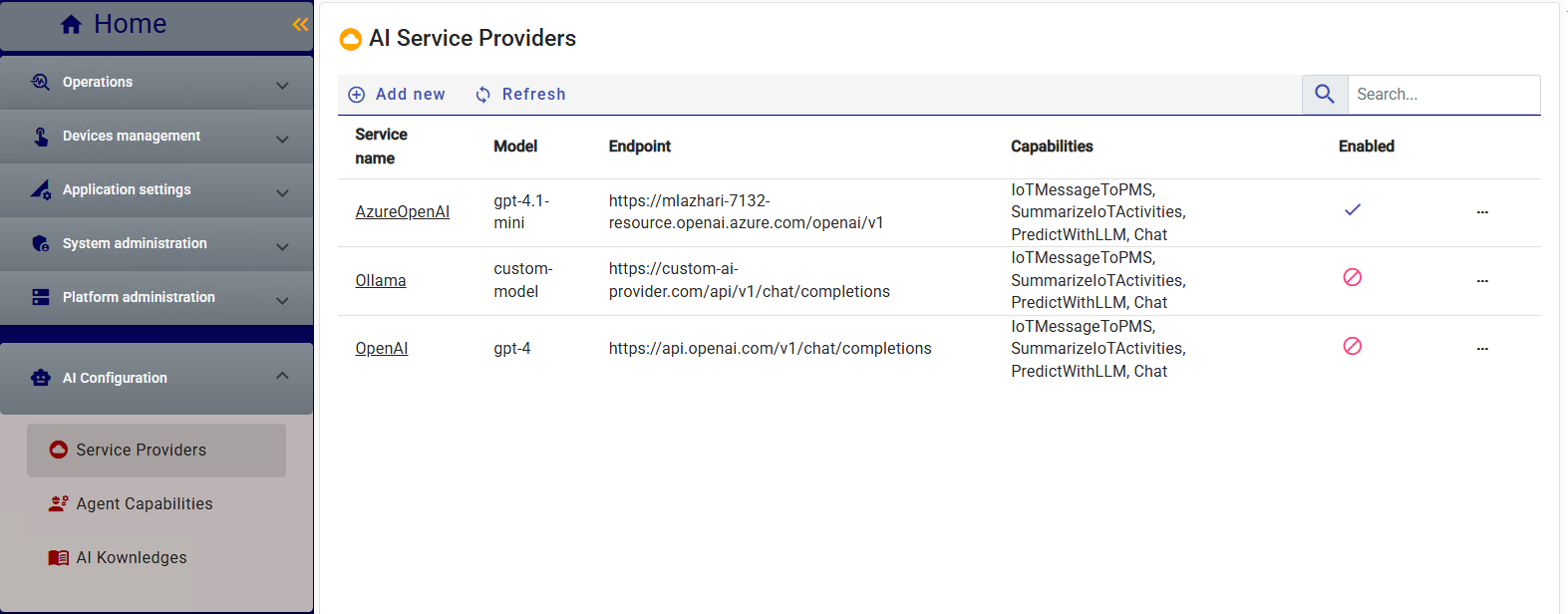
Each provider entry contains:
| Field | Description |
|---|---|
| Service Name | Friendly name of the provider |
| Model | AI model used by the provider |
| Endpoint | API endpoint used for requests |
| Capabilities | AI capabilities assigned to the provider |
| Enabled | Indicates whether the provider is active |
Administrators can quickly identify:
- available providers,
- assigned capabilities,
- active/inactive services,
- and execution routing options.
Creating an AI Service Provider
To create a new provider:
- Open the Service Providers page.
- Click Add new.
- Configure the provider settings.
- Assign the allowed capabilities.
- Enable the provider.
- Save the configuration.
Provider Configuration
Each AI provider contains the following settings.
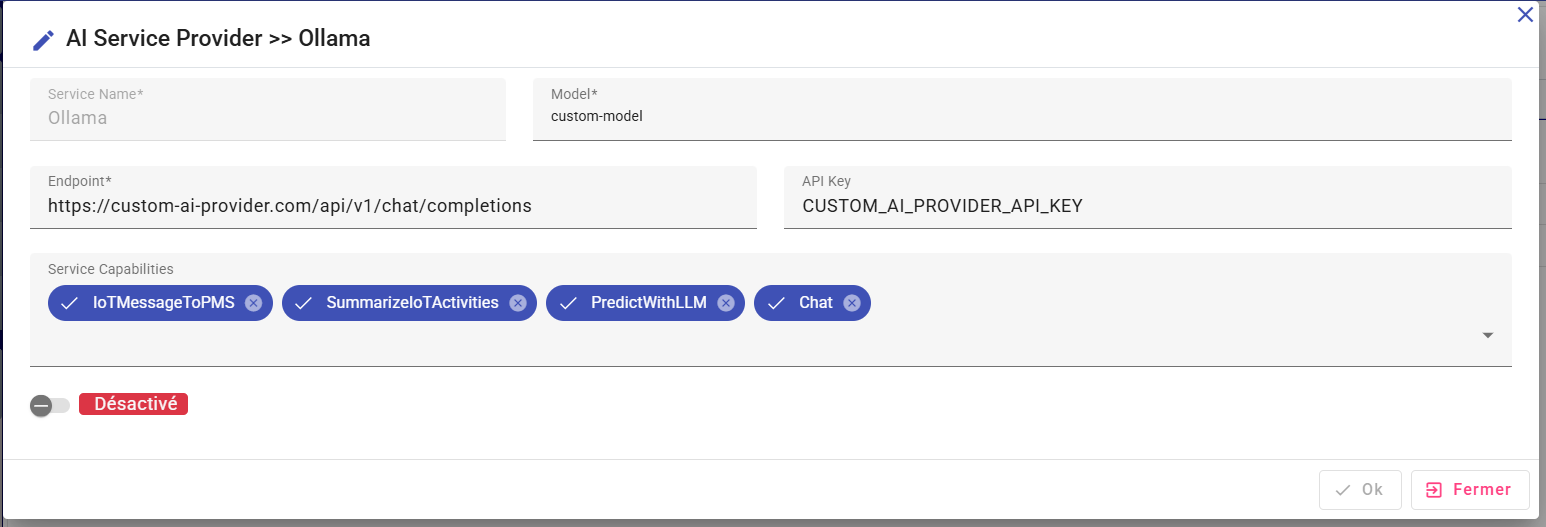
Service Name
A unique display name used to identify the provider inside IoTRoutes.
Examples:
- OpenAI
- AzureOpenAI
- Ollama-Local
- Internal-AI
Model
The AI model used by the provider.
Examples:
- gpt-4
- gpt-4.1-mini
- llama3
- mistral
- custom-model
The selected model determines:
- reasoning capabilities,
- response quality,
- execution speed,
- and operational costs.
Endpoint
The API endpoint used to communicate with the AI provider.
Examples:
- OpenAI API endpoint
- Azure OpenAI endpoint
- Local Ollama server
- Custom enterprise AI gateway
IoTRoutes communicates with providers using API-based integrations.
API Key
Authentication key used to access the AI service.
This field is optional for some local providers but required for most cloud-based providers.
For security reasons:
- API keys should be protected,
- rotated regularly,
- and restricted using provider-side permissions whenever possible.
Service Capabilities
Each provider can execute only the capabilities explicitly assigned to it.
This is one of the core security and governance concepts of the IoTRoutes AI Layer.
Examples of capabilities:
- Chat
- IoTMessageToPMS
- SummarizeIoTActivities
- PredictWithLLM
This mechanism allows:
- workload separation,
- provider specialization,
- secure execution boundaries,
- local-only processing for sensitive tasks.
Example architecture:
| Capability | Provider |
|---|---|
| Chat assistant | OpenAI |
| Device diagnostics | Local Ollama |
| PMS conversion | Azure OpenAI |
| Predictive analysis | Internal AI engine |
Enabling or Disabling a Provider
Providers can be enabled or disabled at any time.
Disabled providers:
- remain configured,
- but are excluded from AI execution workflows.
This is useful for:
- maintenance operations,
- provider migration,
- testing environments,
- temporary failover scenarios.
Architecture Benefits
The AI Service Provider architecture provides several advantages.
Multi-Provider Strategy
Organizations can use multiple AI providers simultaneously.
Benefits:
- high availability,
- cost optimization,
- model specialization,
- reduced vendor dependency.
Security Isolation
Sensitive operations can run exclusively on local providers.
Example:
- internal operational analysis executed using Ollama hosted inside the company infrastructure.
This reduces exposure of sensitive operational data.
Capability Routing
AI tasks can be routed dynamically depending on:
- provider capabilities,
- model specialization,
- security requirements,
- or infrastructure policies.