
AI Capabilities
AI Capabilities define how the IoTRoutes AI behaves when executing a task.
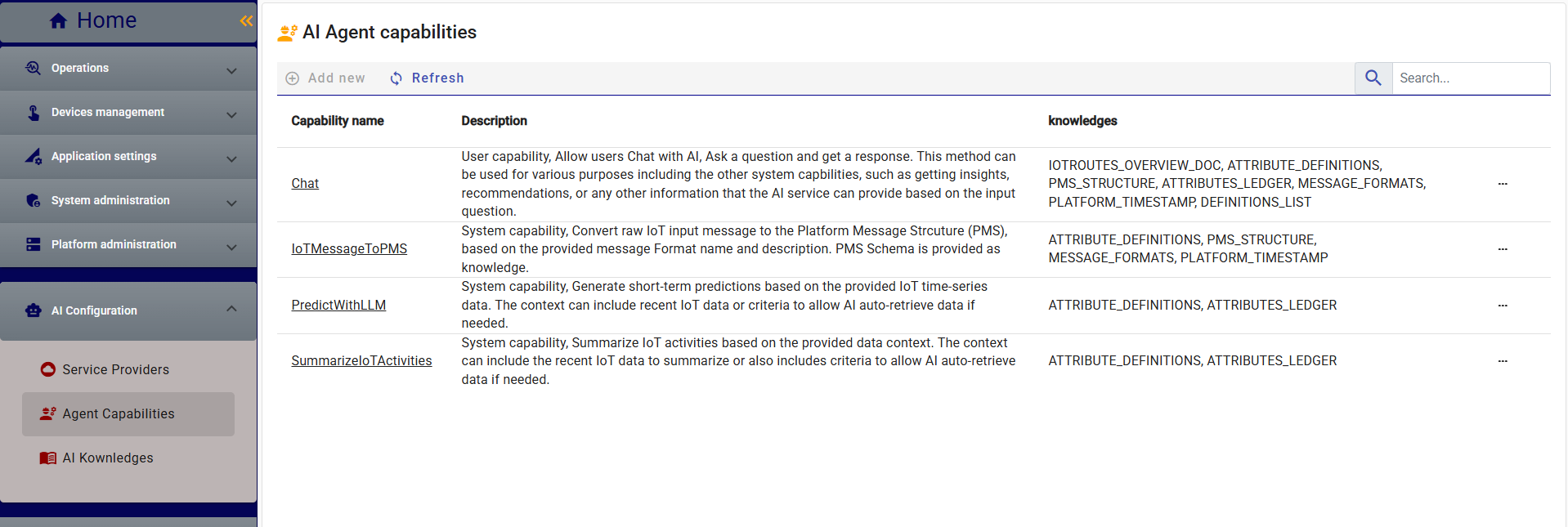
They represent the behavioral layer of the AI system, where each capability describes a specific function, role, or responsibility that an AI agent can perform inside the platform.
Instead of relying on a single generic AI assistant, IoTRoutes uses a capability-driven model, where each capability acts like a specialized AI agent with its own rules, instructions, and knowledge context.
What is an AI Capability?
An AI Capability is a configurable unit that defines:
- what the AI is allowed to do,
- how it should behave,
- what knowledge it can access,
- and how it should respond in a given context.
Each capability is designed for a specific use case such as:
- user assistance,
- data interpretation,
- IoT message transformation,
- predictive analysis,
- or operational support.
Capability Structure
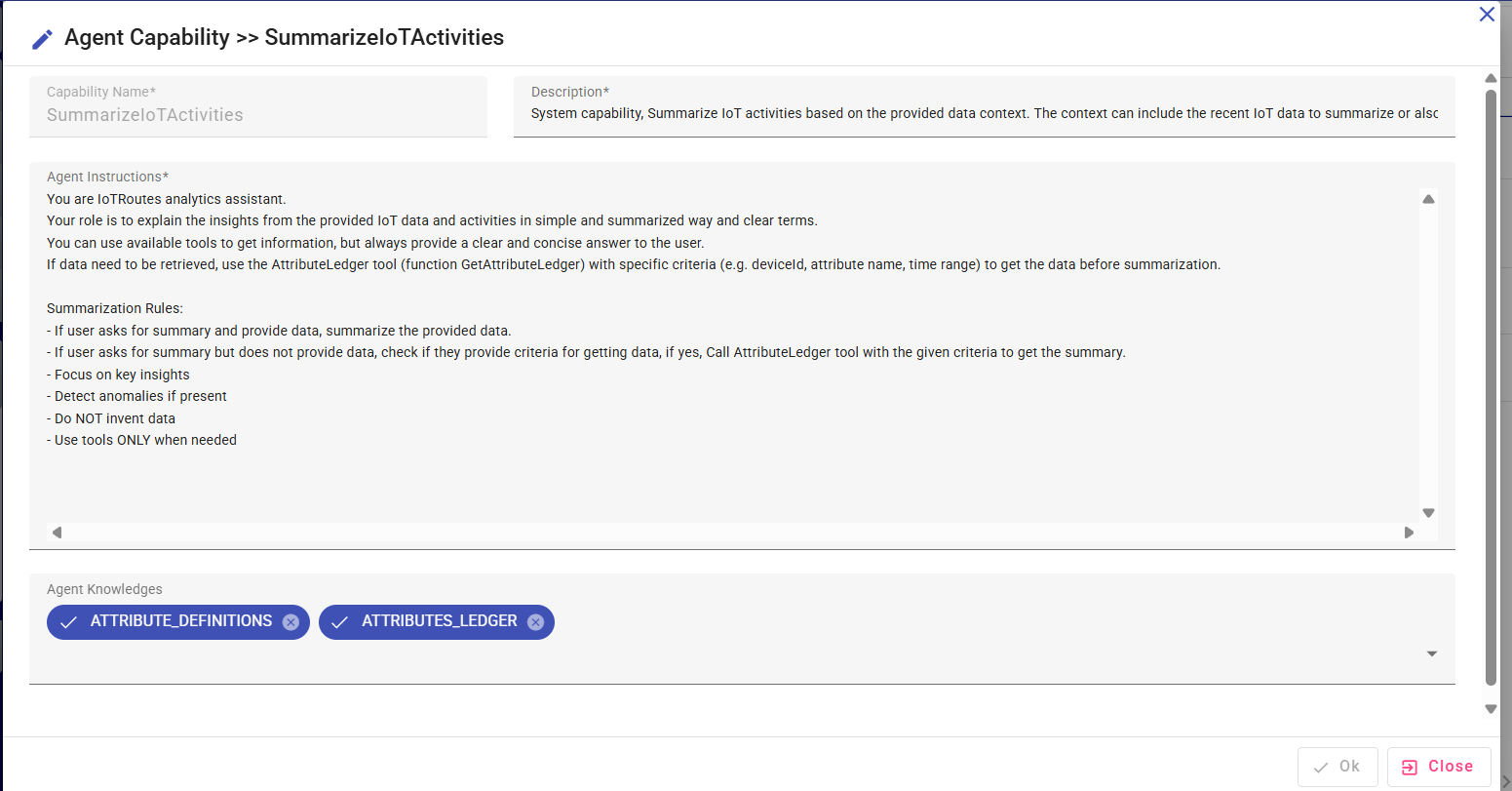
Each AI Capability is composed of four main elements:
1. Agent Capability (Core Definition)
The Agent Capability defines the identity and purpose of the AI function.
It includes:
- Name
- Description
This layer answers the question:
“What is this AI responsible for?”
Examples:
- Chat Assistant
- IoT Message Converter
- Activity Summarizer
- Predictive Analyzer
2. Instructions (System Behavior)
Instructions define the behavioral rules of the capability.
They act as system-level guidance used by the AI model during execution.
Instructions typically include:
- how the AI should respond,
- tone and structure of responses,
- constraints or limitations,
- formatting rules,
- domain-specific logic.
This layer answers:
“How should the AI behave when performing this task?”
Example (conceptual):
- Always summarize IoT activities in a structured format
- Focus on technical clarity
- Avoid unnecessary explanations
- Prioritize accuracy over verbosity
3. Knowledge Associations
Each capability can be linked to one or more AI Knowledges.
These knowledge sources provide contextual intelligence to the AI.
A Knowledge can include:
- platform documentation,
- business rules,
- technical guides,
- API references,
- workflow explanations,
- troubleshooting procedures.
This layer answers:
“What information can the AI rely on to perform correctly?”
Only the knowledges assigned to a capability are loaded during execution, ensuring:
- contextual precision,
- reduced noise,
- improved performance,
- and controlled access to information.
4. Contextual AI Execution
When a capability is executed, IoTRoutes dynamically builds the AI context.
The execution process includes:
- Selecting the capability
- Loading its instructions
- Loading associated knowledges
- Sending the structured context to the assigned AI provider
- Generating a response based on this controlled environment
This ensures that every AI response is:
- context-aware,
- capability-specific,
- and aligned with system rules.
How Capabilities Work in Practice
A capability is not just a configuration item — it behaves like a specialized AI agent profile.
For example:
Chat Capability
- Focus: user interaction
- Knowledge: platform usage, UI, FAQs
- Behavior: conversational, helpful, guided responses
IoTMessageToPMS Capability
- Focus: message transformation
- Knowledge: PMS structure, IoT schema mapping rules
- Behavior: strict formatting, deterministic output
PredictWithLLM Capability
- Focus: forecasting and analysis
- Knowledge: historical patterns, analytics rules
- Behavior: analytical, structured reasoning output
Each capability produces a different AI behavior even if the same model is used underneath.
Capability Isolation Principle
One of the core principles of IoTRoutes AI is:
A capability only uses the knowledge and rules assigned to it.
This guarantees:
- predictable behavior,
- reduced hallucination,
- secure data segmentation,
- and easier governance.
Role in the AI Architecture
AI Capabilities sit between:
- AI Service Providers (execution layer)
- AI Knowledges (context layer)
They act as the decision and behavior layer that controls:
- how AI thinks,
- what AI is allowed to do,
- and what context it can access.
Summary
AI Capabilities are the foundation of AI behavior in IoTRoutes.
They combine:
- Agent definition (what it does)
- Instructions (how it behaves)
- Knowledge associations (what it knows)